
What Should I Do About Dog Aggression At Home?
Published
Updated
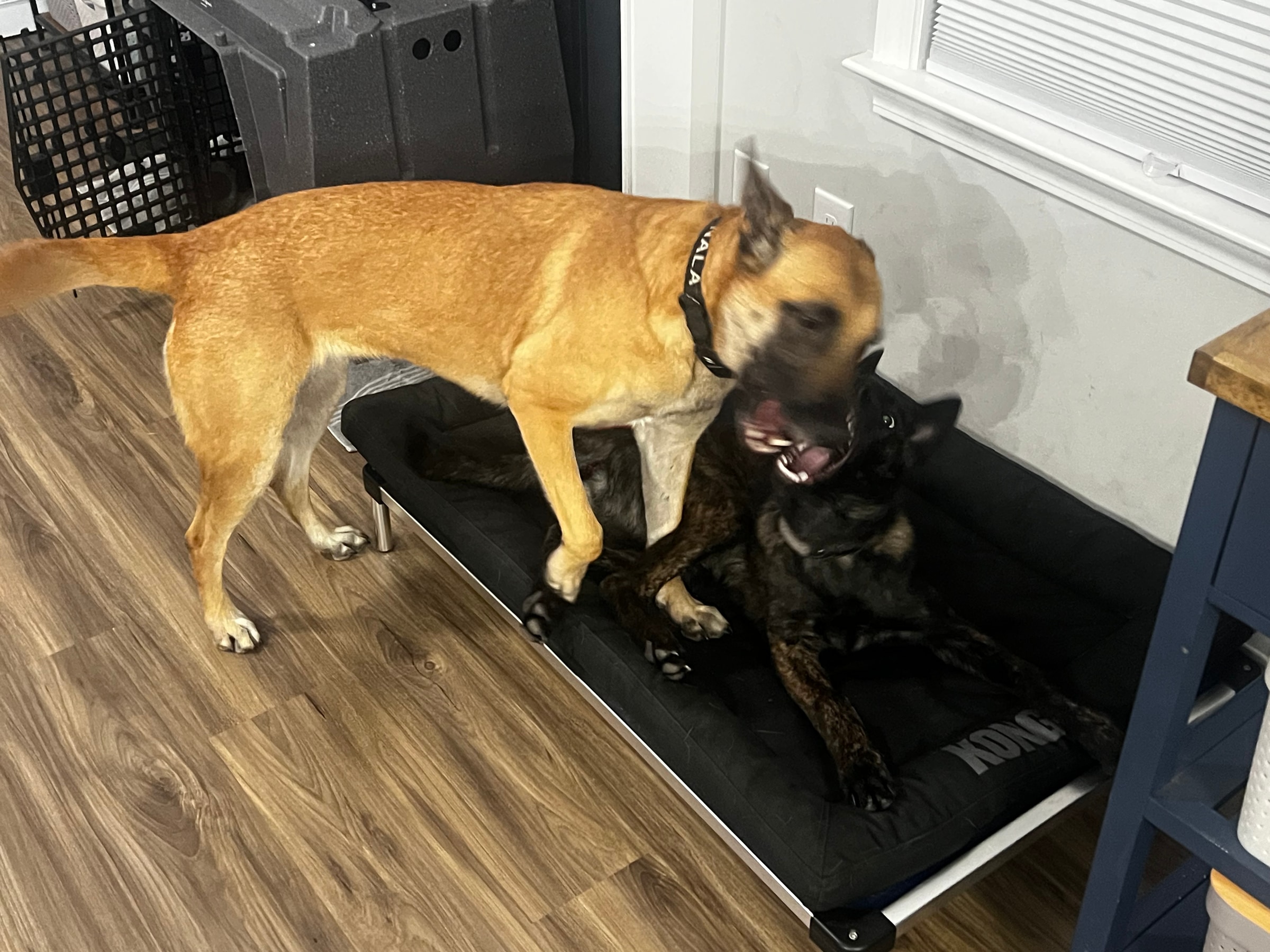
Dog aggression at home needs to be handled as a safety issue first, training issue second. If your dog is going after another dog in the house, the first job is not testing them, hoping they work it out, or waiting for a better day. The first job is stopping the behavior from being rehearsed while you tighten up structure and get clear on what is actually triggering it.
This is also one of the cases where I strongly recommend professional help. Not because there is no hope, but because the fallout is bigger when you guess wrong.
What should I do first if my dogs are fighting at home?
Separate, supervise, and remove chances to repeat it. Do not give the dogs freedom you cannot control.
That usually means going back to basics fast. Crates, leashes, gates, place work, and direct supervision matter here because every aggressive outburst strengthens the pattern. Dogs repeat what works, and if one dog learns that lunging makes the other dog back away, that behavior gets more likely the next time.
A lot of owners accidentally make this worse by only reacting after the blowup. I want you thinking earlier than that. Tight management is not overreacting. It is how you stop one bad pattern from becoming the household normal.
What needs to change in my house right now?
Reduce freedom and remove obvious conflict points. If your dog cannot make good choices consistently, freedom has to shrink.
Start with these:
- Stop unsupervised time together.
- Pick up food, toys, bones, and anything worth guarding.
- Use crates or separation when you cannot actively watch.
- Have dogs drag leashes when appropriate, so you can move them safely without reaching between dogs.
- Keep interactions controlled, short, and boring.
That last one matters. Chaos is not training. It is just a test your dog may fail.
If your house already feels generally loose and inconsistent, read Is My Dog Bad Or Am I Training It?. A lot of behavior problems get bigger because the dog has too much freedom for its current skill level.
Should I correct the aggression, or just prevent it?
Prevention matters more than waiting to correct the incident. If the dog never gets to practice it, the pattern stops getting stronger.
That does not mean you ignore bad behavior. It means you stop setting the stage for it. Owners often focus on the one dramatic moment, growling, lunging, snapping, but the bigger win is stopping the rehearsal that keeps feeding those moments. Structure removes uncertainty, and in cases like this, uncertainty is expensive.
Your communication also has to be clear. If your interrupter word, usually no, means nothing because it gets repeated all day, it will not help when things get tense. Commands and markers need to mean something, and your timing has to be clean.
Can I just use a muzzle and let them work through it?
Not automatically. A muzzle can help in some cases, but it is not a universal fix.
The reason is simple. Dog aggression is not all the same. Fear, frustration, territorial behavior, resource guarding, and space issues do not all respond the same way. In some situations, a muzzle may let you work more safely. In others, especially if the dog is reacting out of fear and you do not understand that, you may just be forcing the dog deeper into stress without solving anything.
That is why diagnosis matters before tools.
How do I know if things are actually getting better?
Look for fewer incidents, lower intensity, and better control at greater proximity. Do not trust your memory alone.
Keep a simple log of when it happened, what was nearby, how close the dogs were, and what set it off. That gives you something real to measure. Without that, most owners end up saying, “I think it’s better,” when what they really mean is, “It hasn’t happened in three days.” Those are not the same thing.
If you want help spotting your blind spots, start by finding your training gap with the free quiz. If you are already dealing with aggression in the home, I would skip guessing and look at booking a 1-on-1 consult.
What is the biggest mistake owners make here?
They move too fast because nothing bad happened for a little while. That is not proof the issue is fixed.
Real progress is not, “They were loose together all afternoon and it seemed fine.” Real progress is, “I know what triggers this, I can interrupt it early, my management is solid, and the dogs are succeeding in controlled setups.” That is a big difference.
If your dog struggles to stay responsive once real life starts happening, you may also want to read Why Does My Dog Only Listen In Training?. Aggression cases are not the place to find out your foundation falls apart under pressure.
The useful distinction here is this. Calm is not the same as safe, and quiet is not the same as solved. With dog aggression at home, good management is not avoiding the problem. It is what gives you a chance to retrain it safely.